Why Investing in NTEP-Certified Conveyor Belt Scales is a Smart Move
by Andy Forrester, Thayer Scale
In the powder and bulk solids industry, precision matters.
Regardless of the material being weighed, accurate measurement can make the difference between regulatory compliance and costly disputes. NTEP-certified belt scales provide legally verifiable, high-accuracy weighing for some of the most challenging industrial environments.
Not all conveyor belt scales are equal.
An NTEP-certified belt scale delivers peace of mind. While not required in all instances, many manufacturing processes can benefit from investing in certified equipment. Rigorous testing and certification ensure accuracy, efficiency and reliability.
NTEP Certification Defined
The National Type Evaluation Program (NTEP) is a certification governed by the National Conference on Weights and Measures (NCWM). It certifies weighing devices for commercial use, ensuring they meet rigorous accuracy and performance standards as outlined in Handbook 44. When a belt scale is NTEP Certified, it is recognized as ‘legal-for-trade’—enabling it to be used for billing or custody transfer applications with confidence.
NTEP certification isn’t just a badge of accuracy—it’s a business safeguard. It ensures that weight measurements used in commercial transactions are consistent, traceable, and legally defensible. The NTEP certification requires that the device meet a tolerance of +0.25 per cent and/or +0.1 per cent and have passed testing to verify its conformance.
Measurement accuracy is critical in conveying materials. Standard conveyor belt equipment is not as reliable as NTEP-certified conveyor belt scales. If a belt scale isn’t properly calibrated, the producer can miscalculate product and lose thousands of dollars or become vulnerable to legal challenges if overcharging customers for inaccurate batches of product.
Replacing low-accuracy belt scales with highly efficient NTEP-certified equipment improves the manufacturing process, resulting in increased return on investment in a short timeframe, as well as increasing legal compliance and ensuring the conveyed material isn’t wasted.
Below: The cost of materials lost by scale inaccuracies can make a BIG difference.
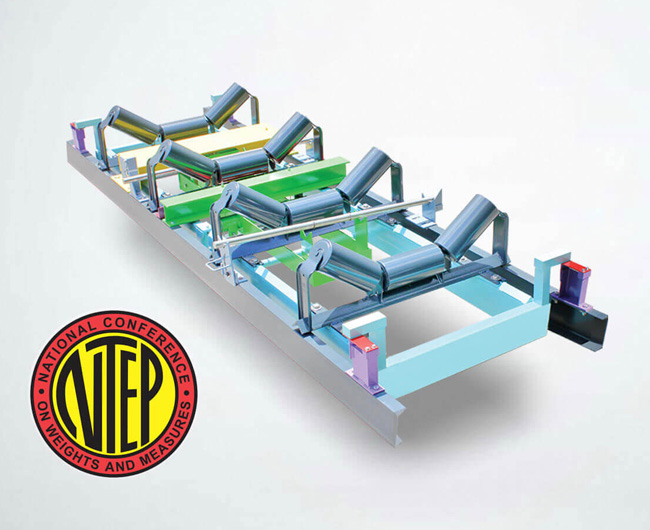
Numerous industries, including pulp and paper, wood pellet production, shipping, truck, rail, and barge loading, fertilizer, mining, ore, copper, and coal depend on belt scales to handle and track high volumes of material with speed and efficiency. These and many other environments demand more than a basic off-the-shelf belt scale. They require a robust, engineered system designed to perform in a wide variety of conditions with consistently high accuracy. Downtime can be costly, reliable equipment and maintenance is key. NTEP-certified belt scales are engineered to perform in the harshest applications. They can last in service for decades, even in the most extreme operating conditions. NTEP-certified belt scales are not just accurate, but the science and engineering behind their design and installation is what makes them stand apart from standard lower-cost belt scales.
On an NTEP-certified conveyor belt scale, measurement sensitivity is high, deflection is low, and the load cell is isolated from the error-inducing effects of extraneous lateral forces, off-center loading, foundation distortion, inclination hold-back forces, and high sporadic shocks and overloads. Tare load is mass counterbalanced to create a superior signal-to-noise ratio in weight sensing, orders of magnitude better than belt scale designs supporting full tare load on the load sensor.
Delivering ROI
The case for NTEP Certified Belt Scales goes beyond compliance, it is good business. Consider the cost of overfilling rail cars or trucks by 2-3% due to poor belt scale accuracy. Those errors multiply quickly over hundreds of loads. Add in the potential for customer disputes, regulatory fines, and rework, and it becomes clear that accurate weighing isn’t just a technical upgrade—it’s an operational necessity.
Using NTEP-certified equipment can also protect companies from legal risk and billing disputes. It ensures consistency in measurements and provides documentation that can be used to resolve discrepancies. It also fosters customer trust, particularly in high-value, high-volume industries where even minor weighing variances can have significant financial implications.
Routine calibration can be simplified with automated test weight systems, which enables calibration with the press of a button, minimizing downtime and removing the need for operators to manually position weights on moving conveyors.
The use of an NTEP-certified belt scale makes sense if the transfer of material involves billing or legal implications, when target loadouts are critical, if customer-facing delivery receipts or invoices are based on weight and to avoid loss prevention audits.
NTEP-certified for trade belt scales provide legal-for-trade certification and confidence. They deliver high accuracy and deliver ROI.