


Unlike competitive solutions, the Thayer Scale Bridge Breaker flow aid vibrates only the material contained within a vessel—it does not transmit vibrations to the vessel’s walls.
The Bridge Breaker flow aid ensures reliable discharge of materials that tend to bridge or cake due to compaction or cohesion preventing free and consistent material flow. Its design solves one of the biggest problems encountered in highly automated process industries: the reliable removal of bulk solids from storage bins or hoppers.
Having trouble with material bridging?
Thayer Scale can help evaluate your material, hopper design, and feeding process to determine whether a Bridge Breaker Flow Aid is the right solution for your application.
Why Choose The Bridge Breaker Flow Aid?
🔧 Shakes the material, not the bin
Rapid vibrating motion applied to internally mounted, isolated screens, reduces stress and damage to the bin or hopper.
🔇 Whisper-quiet operation
Motion applied through isolated internal screens for less audible noise compared to other typical vibrator, knocker or air solutions.
🔄 Adapts to square or circular bins
Configurable to fit a wide range of bin, hopper, and chute sizes and shapes.
🔧 Simple bolt-to-bin installation
Easily installs on existing equipment with minimal modification.
💲 Lower cost to buy and install
Simple, lightweight components installed on existing vessels reduce both upfront cost and installation time.
Easily installs in existing bins, hoppers and chutes.
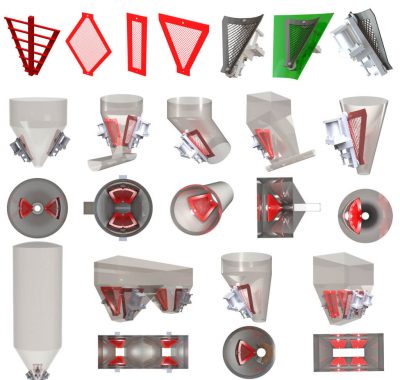
ANY SHAPE! ANY SIZE!
How the Bridge Breaker Flow Aid Restores Flow
Thayer Scale’s Bridge Breaker Flow Aid works by applying mechanical agitation to the hopper or material-contact area to collapse the bridge and reestablish consistent discharge.
- Material Stops Flowing
Inside the hopper, material may compact and form a bridge above the discharge opening. This prevents product from reaching the feeder, conveyor, or process below. - The Bridge Breaker Flow Aid Activates
he Bridge Breaker Flow Aid shakes the material not the bin. It applies a controlled force or motion to the hopper area where bridging typically occurs. - The Material Arch Collapses
The mechanical action breaks the bridge, loosens the material, and allows gravity to resume pulling product toward the outlet. - Free Flow
Once the bridge is broken, material moves consistently into the downstream equipment. This helps maintain a steady feed rate and supports more reliable weighing, batching, or process control.
Who Needs The Bridge Breaker Flow Aid?
The Bridge Breaker may be the right solution if your process experiences:
- Material sitting in the hopper while the feeder runs empty
- Operators hitting the hopper to restart flow
- Inconsistent feed rates
- Frequent bin or hopper blockages
- Material discharging suddenly after a delay
- Poor batching accuracy caused by irregular flow
- Visible dents or damage from manual impact
- Downtime caused by material hang-ups
About Our Bridge Breaker Flow Aid’s Design
Without Bridge Breaker

With Bridge Breaker
The Bridge Breaker flow aid is constructed from either expanded metal or bar screens and designed to suit individual bin configurations.
Thayer Scale Bridge Breaker flow aid screens are available in three types: triangular, rectangular, and diamond. Each design ensures proper alignment with the bin wall to maximize vibration transfer and eliminate bridging.
The screens are internally mounted, parallel to the bin walls. An externally-mounted vibrator transmits a rapid vibrating action to the screens by means of isolated bolts that pass through the bin wall.
The bolts pass through vibration mounts, permitting the Bridge Breaker flow aid screen to vibrate freely without transmitting any motion to the bin walls. The unique design is exceptionally quiet and reduces bin weld fatigue (a flaw commonly associated with flow aids that transmit vibrations to bin walls).
The screen is placed at critical points in the bin where bridging or arching might occur. Continuous operation of the Bridge Breaker flow aid during discharge prevents bridges and arches by undercutting the bridge or arch and sending the material to the bin’s discharge point. This process ensures the continuous flow of material.
The motion of the vibrating screen is always parallel with the sides of the bin, so the vibration does not compact the material. The customizable screen sections adapt to either flat or conical surfaces.
The screen assemblies fit areas of up to ten square feet, depending on the type of material and bin configuration. While many Bridge Breaker flow aids can be mounted within a bin, only a few are needed—if placed at critical points— to successfully prevent bridging and arching. More screens may be required when the hopper size is larger or a more difficult material is being discharged.
Video: See The Bridge Breaker Flow Aid In Action
Common Uses of The Bridge Breaker Flow Aid
The Bridge Breaker Flow Aid is typically used with dry bulk solids that are prone to compaction, arching, or inconsistent discharge.

Thayer Scale’s Bridge Breaker material flow aid prevents bridging and ratholing of:
- Activated carbon
- Adipic acid
- Aluminum powder
- Ammonium nitrate
- Animal protein
- Biomass
- Calcium carbonate
- Carbon black
- Carbon dust
- Carboxy methyl cellulose
- Cellulose powder
- Cement
- Ceramic mix
- Chalk
- China clay
- Cuprous oxide
- Diatomaceous earth
- Dried bone meal
- Dried onions
- Dry table salt
- Fiberglass
- Fire clay
- Flour
- Foundry sand
- Grain
- Graphite
- Ground alumina
- Ground malt
- Gypsum
- Instant coffee
- Iron oxide
- Iron pyrites
- Lime
- Lime dust
- Malt
- Melamine
- Milk powder
- Oats
- Peanuts
- Pet Food
- Plastic powder
- Plastic resin
- Polyethylene flake
- Polypropylene
- Potash
- Potato starch
- Powdered chocolate
- Prills
- Protein powder
- PTFE
- PVC regrind
- Resin
- Rubber
- Rye meal
- Saw dust
- Silica
- Soap powder
- Soda ash
- Sodium bicarbonate
- Sodium silicate
- Spent grain
- Starch
- Sugar
- Sulphur
- Super phosphate
- Tobacco
- Vegetables
- Wet corn fiber
- Whole corn
- Wollastonite
- Wood chips
- Zeolite
- Zinc stearate
Did you know? Bridge Breaker flow aids are suitable for hard-to-handle materials such as titanium dioxide, clays, and pigments.
Case Studies
How The Bridge Breaker Flow Aid Solved Real Material Bridging Challenges

1: Eliminating Bridging in Spent Grain Storage
Problem: Spent grain in a 33-ton storage hopper would not discharge properly after settling. Standard vibrators were too noisy and ineffective, while air lances and manual hammering were costly and damaging to the hopper.
Solution: Three Thayer Scale Bridge Breaker flow aids were installed.
Result: Bridging was eliminated, restoring consistent free flow without damaging equipment.

2: Restoring Flow in Wood Particle Board Handling
Problem: Light, fluffy wood particle material bridged across the entire hopper, preventing discharge into a screw feeder.
Solution: Six Bridge Breaker flow aids were interlocked to activate with the screw feeder.
Result: Bridging was eliminated, enabling reliable, synchronized discharge and improved process consistency.

3: Stabilizing Flow in Large PVC Storage Silos
Problem: PVC pellets in a 21 ft diameter × 70 ft high silo experienced erratic flow due to bridging when feeding into a pneumatic conveying system.
Solution: Two Bridge Breaker flow aids were installed, with adjustable vibration amplitude via air pressure.
Result: Achieved continuous, uniform flow without bridging interruptions.

4: Ensuring Timely Discharge of Alumina Powder
Problem: Alumina powder in a weigh hopper (45° slopes, 8″ outlet) would not discharge within required cycle times.
Solution: Two Bridge Breaker flow aids installed 180° apart.
Result: Delivered complete discharge within required time while maintaining quieter operation compliant with regulations.

5: Improving Coal Flow in Coke Oven Operations
Problem: Damp coal in larry hoppers failed to discharge within batch cycle time. Standard vibrators were ineffective.
Solution: Two Bridge Breaker flow aids installed in sloped hopper walls.
Result: Enabled on-time, complete discharge and reduced worker exposure to hazardous manual intervention.

6: Boosting Throughput in PVC Resin Processing
Problem: PVC resins flowed poorly (≈10 lbs/min) into an extruder and were unevenly dispersed.
Solution: A single Bridge Breaker flow aid with an extension into the extruder throat.
Result: Increased material flow by 100%, achieved uniform dispersion and improved overall system throughput.
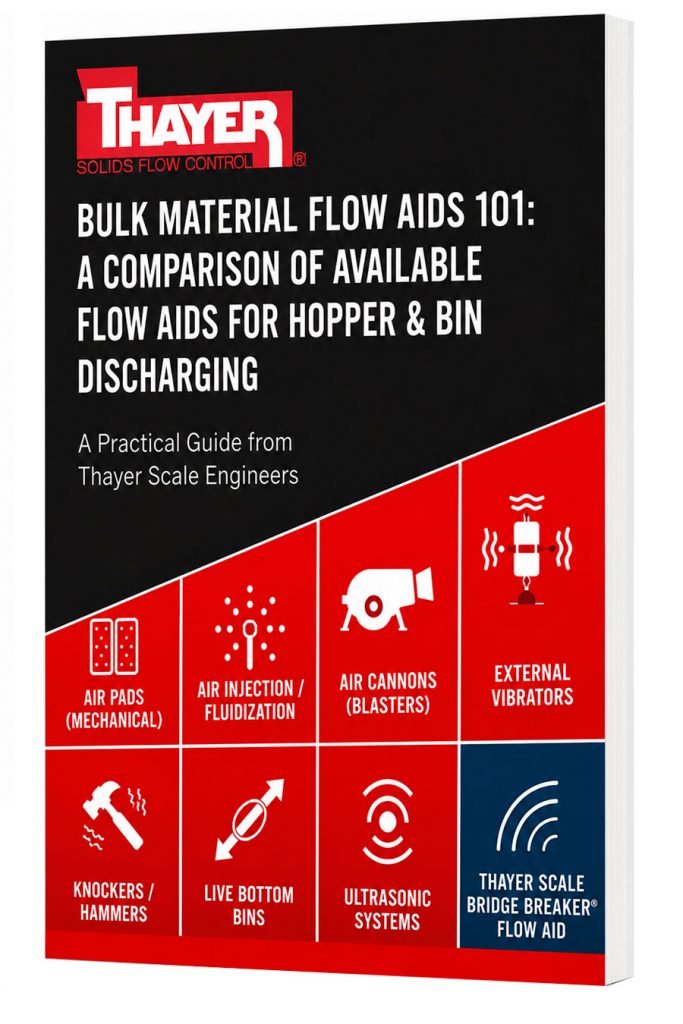
Bulk Material Flow Aids 101: A Comparison of Available Flow Aids for Hopper & Bin Discharging
Thayer Scale engineers provide a practical comparison of available flow aids and explain each technology’s primary strengths, limitations and best applications.
- Understand bridging vs. ratholing and other flow obstructions
- Compare flow aid technologies side by side
- Evaluate strength, limitations and best applications
- Match the right solution to your material and equipment
- Improve discharge reliability and process performance