

CONVEYOR BELT SCALE
How To Achieve Conveyor Belt Scale Accuracy: An Engineering Guide
by Thayer Scale Engineering Staff
The Fundamental Challenge of Continuous Weighing
Unlike static weighing, conveyor belt scales operate in a dynamic environment where material is continuously moving across the weighing system. The conveyor belt itself is also under tension as it transports material through the process.
That tension is not always constant. It can vary along the conveyor and over time and can introduce forces that a poorly designed scale will misinterpret as material weight.
This is the fundamental challenge of continuous weighing: the scale (unless engineered otherwise) is subject to a wide range of forces that may not represent true material weight.
In real-world bulk material handling, even small percentage errors compound quickly—leading to product giveaway, inventory discrepancies, and process inefficiencies. These losses rarely appear as obvious failures, but instead as unexplained variance and margin erosion.
How can these challenges be overcome for accurate continuous weighing? Before we dive into how to engineer conveyor belt scales for accuracy, let’s define it.
Conveyor belt scale accuracy defined
Conveyor belt scale accuracy is typically specified as the allowable percentage deviation between the scale’s indicated totalized weight and the actual material weight over a defined operating range and set of conditions.
High-accuracy conveyor belt scales may be rated for performance such as ±0.125%, ±0.25%, or ±0.5%, depending on factors including weighbridge design, conveyor conditions, loading range (turndown), installation quality, and calibration practices.
Measurement error is commonly calculated as:
Measurement Error % = ((Measured Total – Actual Total) / Actual Total) *100
This measured error reflects the performance of the complete conveyor weighing system, including:
⚖ Load measurement
⏱ Belt speed measurement
⚙ Conveyor mechanics
🛠 Installation quality
☁ Environmental influences
◎ Calibration procedures
It is also important to distinguish between two key components of measurement performance:
- Bias Error — a consistent offset from the true value
- Repeatability — the degree to which measurements remain consistent under identical operating conditions
✓ A truly accurate conveyor belt scale system must control both — delivering measurements that are not only close to the true value, but also stable and repeatable over time.
Unfortunately, many belt scales are installed on conveyors that were not originally engineered with high-accuracy weighing in mind. Achieving high performance is not the result of a single component, but rather a coordinated system design that controls mechanical forces, stabilizes the weighing environment, and maintains long-term calibration stability. This is why close collaboration between the conveyor engineering team and the belt scale supplier is essential.
How to Engineer Conveyor Belt Scales for Accuracy: Two Primary Considerations
Two primary factors that determine accuracy:
- Conveyor design & characteristics (the environment)
- Weighbridge design (the measurement system)
Conveyor Design & Characteristics: Creating a Stable Weighing Environment
The conveyor establishes the mechanical conditions in which the scale operates and therefore plays a dominant role in achievable accuracy. The following design considerations are critical to creating a stable and predictable weighing environment:
◎ Scale Position
The scale should be installed in a low-tension zone, typically near the tail pulley. Lower belt tension reduces the influence of belt stiffness, stretch, and transient forces acting on the weighbridge. High-tension areas amplify small mechanical inconsistencies into measurable errors, so positioning the scale where forces are naturally minimized improves baseline accuracy and stability.
⬇️ Material Loading Point Design
A single, well-controlled loading point is ideal. Multiple feed points or uneven loading introduce fluctuations in belt tension and create inconsistent material profiles. This leads to variations in the measured load that are not representative of actual mass flow. A consistent, centered feed helps ensure the scale sees a uniform and repeatable load signal.
↕ Take-Up System Type and Size
The take-up system controls belt tension. Gravity take-ups are preferred because they automatically adjust to changing load conditions, maintaining more consistent tension as the conveyor operates. Proper sizing of the gravity take-up is equally important. An oversized or excessively heavy take-up can over-tension the belt and reduce the natural belt sag between idlers that is necessary for stable and repeatable load measurement. In contrast, fixed or screw take-ups cannot respond dynamically, which can result in tension variations between calibration and operation—one of the primary contributors to measurement error.
▭▭ Idlers & Alignment
Idlers define the mechanical path of the belt and directly influence how forces are transmitted to the scale. Uniform idlers with tight tolerances help maintain a consistent belt profile. Proper vertical alignment — especially the scale idlers and the adjacent idlers immediately before and after the scale location — is critical because misaligned idlers introduce additional belt tension forces and vertical disturbances that the scale may interpret as weight, resulting in measurement error. While perfect alignment is difficult to maintain, minimizing deviation reduces unnecessary measurement error and improves overall accuracy.
➝➝ Adequate Material Settling Distance
Material must be given enough distance after loading to settle into a stable, uniform cross-section before reaching the scale. Immediately downstream of a loading point, material is often turbulent, unevenly distributed, or subject to changing impact and acceleration forces as the conveyed material transitions to belt speed. Locating the scale in this zone leads to erratic readings. Providing sufficient settling distance allows the material to stabilize, resulting in a more stable and accurate signal.
The most successful belt scale installations combine good conveyor design with scale technologies that minimize sensitivity to these unavoidable inconsistencies.
Weighbridge Design: Measuring Only What Matters
Once the conveyor environment is controlled, the focus shifts to the weighbridge, where the goal is to measure net load while rejecting everything else.

Net Load vs. Dead Load
One of the most important principles in accurate weighing is dead load vs. net load. In most conveyor belt scale designs, the load sensor supports both the weight of the conveyed material (net load) and the weight of the conveyor components themselves (dead load), including the belt, idlers, and weighbridge structure.
This results in the load cell measurement range being dominated by dead load, with only a small portion available for actual measurement—reducing sensitivity and increasing error. High-accuracy systems address this by mechanically counterbalancing dead load, allowing the sensor to respond primarily to material weight. This dramatically improves signal-to-noise ratio and measurement resolution.
⎍ WeighBridge Architecture
The weighbridge architecture — whether full-floating, pivoted, or approach/retreat — fundamentally determines how conveyor forces are transmitted to the load sensor and therefore has a major influence on achievable accuracy.

Full-floating weighbridges act primarily as force-summing devices, combining the vertical forces transmitted through the weighed idlers. While mechanically simple, these designs are generally more sensitive to idler alignment, off-center loading, belt tension variation, and external structural influences. Because the weighbridge is free-floating, it must also be mechanically restrained to prevent movement along the conveyor axis. This is typically accomplished using check rods or stay rods, particularly on inclined conveyors. These restraint systems can introduce additional force interactions during operation that may differ from those present during calibration, contributing to measurement error.
Pivoted weighbridges operate differently. By supporting the weighbridge on a fulcrum or pivot, the system measures moments rather than simply summing forces. This creates varying sensitivity across the weighbridge, with the idlers nearest the pivot being less sensitive to alignment-related errors and tension-induced disturbances. The rigid pivot structure also provides an inherently stable mechanical reference point, eliminating the need for external restraining devices and improving long-term repeatability and stability.
Approach/retreat weighbridges extend this concept further by utilizing opposing pivot arrangements that naturally compensate for many common conveyor-induced errors. Because the approach and retreat sections respond oppositely to certain alignment and tension effects, a portion of these errors is effectively cancelled within the weighing system itself. This architecture also reduces sensitivity to variations in belt tension and improves long-term stability in demanding conveyor applications.
In general, pivoted and approach/retreat weighbridge designs are preferred for high-accuracy conveyor belt scale applications because they reduce sensitivity to idler misalignment, belt tension variation, and other conveyor-related mechanical influences. Their rigid pivot structures also provide improved mechanical stability, particularly on inclined conveyors where full-floating designs may require additional restraining mechanisms such as check rods or stay rods to prevent the weighbridge from shifting under the influence of gravity and belt forces.
Full-floating weighbridges remain widely used and can provide excellent performance in many conveyor applications, particularly where installation simplicity, lower cost, or shorter weigh spans are important considerations. However, because these designs are generally more sensitive to alignment conditions, belt tension variation, and external mechanical influences, careful attention must be given to idler alignment, belt tension management, and overall conveyor design to achieve optimal accuracy.
≈ Weighbridge Length and Signal Stability
Weighbridge length also plays a critical role in weighing accuracy. Multi-idler designs increase material residence time (the time material remains on the weighbridge) and reduce the relative impact of fixed mechanical errors, effectively smoothing the measurement signal. Residence time becomes especially important on high-speed conveyors. On very short weighspans, rapid surges or localized variations in material loading may pass across the scale so quickly that the weighing system and integrator have insufficient time to fully sense and integrate the change in loading. A longer weighbridge effectively increases the measurement window, improving the system’s ability to accurately capture transient loading conditions that might otherwise be under-measured or missed entirely.
Importantly, this benefit is achieved only with true multi-idler weighbridge designs where the weighing sections function as an integrated mechanical system. Simply combining multiple independent single-idler scales does not provide the same averaging effect or improvement in residence time.
Ultimately, weighbridge design is about controlling sensitivity—ensuring the system responds to material weight while minimizing the influence of mechanical disturbances.
Belt Speed Measurement and Accuracy
Even a perfectly accurate load measurement will produce errors if speed is measured incorrectly. Accurate conveyor belt systems will measure speed directly from the moving belt itself rather than inferred from the rotational speed of a drive pulley. Because belt stretch varies along the conveyor length, speed must be measured directly from the belt near the scale location, reflecting actual material movement—not assumed from drive components.
Drift and Environmental Effects
Accuracy is not static. A system may be accurate immediately after calibration, but over time that accuracy will degrade if drift is not controlled.
Drift is the gradual shift in measurement caused by factors such as material buildup on the weighbridge, temperature-induced belt stretch, and mechanical changes within the system. These effects introduce increasing error into both load and speed measurements, leading to incorrect totalized values if left uncorrected.
Managing drift requires both design and discipline: designs that minimize buildup and compensate for environmental effects, combined with operational practices such as automatic zero calibration and regular verification.
Thayer Scale Technologies That Drive Conveyor Belt Scale Accuracy
Over 75 years ago, Thayer Scale began innovating continuous weighing and feeding systems for the dry solids conveying and processing industries. Today, our custom-engineered equipment is trusted worldwide for precise flow measurement and built-to-survive reliability.
Our high-accuracy systems address each of the challenges of weighing accuracy, including parasitic forces, sensitivity to idler misalignment, inaccuracies due to slip and stretch, the influence of dead load, and frequent, human-centric calibration routines and diagnostics.
Each of the below Thayer Sale technologies addresses a specific source of error, reinforcing the central principle: accuracy is achieved by controlling the system, not just improving the sensor.
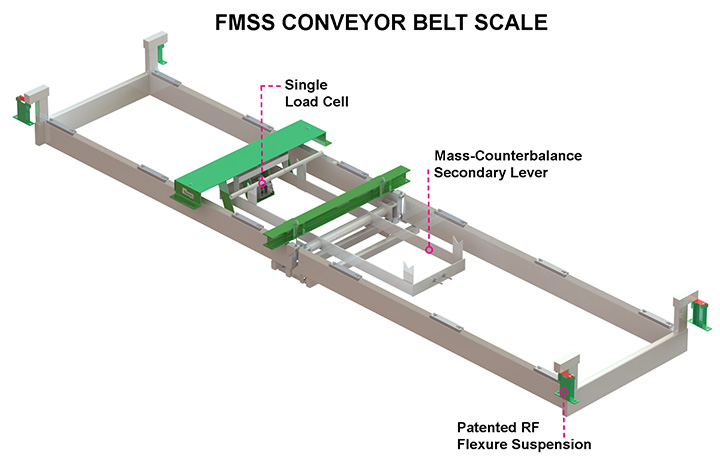
🔁 Rocking Flexure Suspension Weighbridge: Isolates Load Cells to Measure Only True Vertical Weight
Thayer Scale’s Rocking Flexure Suspension Weighbridge is designed to address one of the fundamental limitations of conventional belt scales: the introduction of parasitic forces into the load measurement.
In a typical installation, lateral forces, off-center loading, and structural interactions within the conveyor can all distort the signal seen by the load cells.
Our rocking flexure design mechanically isolates the weighing system from these influences by allowing controlled movement only in the vertical direction while resisting horizontal and torsional forces. As a result, the load cells respond primarily to true material weight rather than external disturbances, improving signal clarity, repeatability, and overall measurement stability.
Thayer Scale’s FMSS technology enables significantly higher load cell utilization

⚖️ Mass-Counterbalanced Scale: Maximizing Sensitivity to Material Load
Thayer Scale’s mass-counterbalanced conveyor belt scale design mechanically offsets a large portion of the conveyor dead load — including the weight of the belt, idlers, and weighbridge structure — allowing the load sensor to respond more directly and sensitively to changes in material weight. This improves load cell utilization, strengthens the effective weighing signal, and increases resistance to measurement disturbances caused by vibration, belt tension variation, and other mechanical influences. This approach significantly improves signal-to-noise ratio and weighing resolution compared to conventional designs where dead load dominates the sensing system.
FMSS (Force Measurement Suspension System): Reducing Sensitivity to Conveyor Disturbances
In conveyor belt scale applications, the weighing system is constantly exposed to external mechanical influences including vibration, structural deflection, belt tension variation, misalignment, and transient conveyor forces. These disturbances can degrade weighing accuracy if they are transmitted directly to the load sensor.
Thayer Scale’s Force Measurement Suspension System (FMSS) incorporates a specialized mechanical suspension and mass-counterbalancing design that helps isolate the sensing system from many of these unwanted forces while reducing the percentage of the load cell’s operating range consumed by conveyor dead load. This improves load cell utilization, enhances signal stability, and reduces sensitivity to vibration and structural movement. The result is a more stable and repeatable weighing signal under real-world conveyor operating conditions.

🌀 Precision Belt Speed Sensing: Accurate Belt Speed Measurement Independent of Slip and Stretch
Accurate belt speed measurement is essential for precise conveyor scale performance. Even small speed measurement errors directly affect totalized weight and flow calculations. Conventional systems that infer belt speed from drive pulleys or conveyor components can introduce errors due to belt slip, belt stretch, changing tension conditions, and mechanical tolerances within the conveyor drive system.
Thayer Scale’s Precision Belt Speed Sensing Technology measures actual belt travel directly at the conveyor belt using a precision-machined speed sensing wheel and spring-loaded contact assembly designed to maintain stable engagement with the moving belt. The design minimizes the effects of material buildup, vibration, and inconsistent belt contact while providing a highly repeatable speed signal under varying operating conditions.
By measuring true belt travel near the scale location, the system improves the accuracy and stability of mass flow calculations — particularly in high-accuracy conveyor belt scale applications where small speed measurement errors can significantly affect overall system performance.
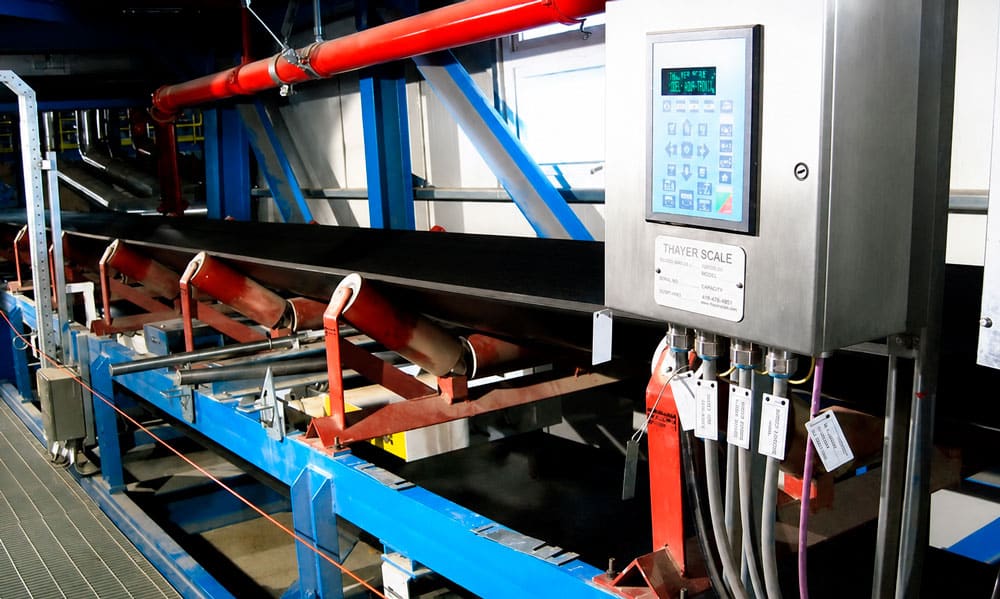
🧠︎ Intelligent Controls and Calibration Systems: Maintaining Long-Term Accuracy
Maintaining conveyor belt scale accuracy over time requires more than a well-designed weighbridge. Environmental conditions, material buildup, changing belt conditions, and normal conveyor wear can gradually affect system performance if not routinely monitored and corrected.
Thayer Scale’s advanced belt scale integrators — including the Series 5200 and WeighPoint® platforms — incorporate advanced calibration, diagnostic, and compensation algorithms designed to maintain long-term measurement stability under real-world operating conditions. Features such as automatic zero calibration routines, calibration history tracking, diagnostic monitoring, and environmental compensation continuously support system accuracy and repeatability. Advanced functions such as Scale Location Compensation (SLC) further improve performance in complex conveyor layouts by compensating for material transport delays and changing process conditions.
Together, these instrumentation technologies simplify routine verification procedures, improve long-term repeatability, and reduce the operational burden associated with maintaining high-accuracy conveyor belt scale systems.
What Is NTEP Certification—and Why It Matters
NTEP-certified conveyor belt scales are in-motion weighing systems that have been independently tested and approved under the National Type Evaluation Program (NTEP) for use in legal-for-trade applications. Certification verifies that the complete weighing system meets defined performance and repeatability standards under real-world operating conditions.
NTEP-certified scales are commonly used in applications involving commercial material transfer with billing or legal custody implications, rail or truck loadouts with target weights, customer-facing delivery receipts or invoices based on weight or internal reconciliation or loss prevention audits.
NTEP certification isn’t just a badge of accuracy — it is a business safeguard. It ensures that weight measurements used in commercial transactions are consistent, traceable, and legally defensible. High-accuracy NTEP-certified conveyor belt scales — particularly multi-idler certified-for-trade systems — can achieve ±0.125% accuracy when properly engineered, installed, calibrated, and maintained.
💰 ROI-Driven Performance with Rapid Payback
Even relatively small weighing errors can create significant financial losses in high-throughput conveyor applications. Consider the cost of overfilling rail cars or trucks by 2-3% due to poor belt scale accuracy. Add in the potential for customer disputes, regulatory fines and rework, and the ROI and financial payback of investing in NTEP conveyor belt scale is clear. In many cases, ROI can be achieved in as little as six months.

Accuracy is Engineered through Decades of Experience.
High accuracy in conveyor belt scale systems is not the result of a single component or piece of equipment. It is the outcome of a coordinated design approach that controls mechanical forces, stabilizes the measurement environment, and maintains performance over time.
Conveyor design, weighbridge architecture, belt tension management, idler alignment, speed sensing, instrumentation, and calibration strategy must all work together as an integrated system. When these variables are properly analyzed and engineered, modern conveyor belt scales can deliver exceptional accuracy, repeatability, and long-term stability — even in harsh industrial environments handling thousands of tons per hour.
Contact Thayer Scale’s Continuous Weighing Experts
For more than 75 years, Thayer Scale has specialized in designing and manufacturing continuous weighing systems for demanding bulk material applications. If accuracy matters to your operation, a system-level engineering approach is essential. Reach out to our team to discuss your application and explore the right solution for your process.