

Why does Thayer Scale offer 4 different scale types for its range of weigh belt feeders?
by Andy Forrester
Look closely at our competitors’ weigh belt feeders, and you’ll notice a pattern: many are simply a conveyor belt scale — single or dual idler — fit into a small, enclosed, self-contained belt feeder.
It’s an understandable shortcut, but it’s the wrong place to start.
A typical belt conveyor has fundamentally different characteristics from a weigh belt feeder. Belt speed, belt width, belt load, idler design, idler spacing, open vs. closed construction, sanitation requirements all differ — the list goes on.
In other words, a design that performs well as a conveyor belt scale often struggles to deliver accurate, reliable and repeatable results in a weigh belt feeder application. This is precisely the problem Thayer Scale set out to solve when it engineered its first purpose-built weigh belt feeders in the 1960s.
Rather than trying to cover every application with a single scale design, Thayer Scale has continued to develop and refine four distinct families of scale types for weigh belt use. Thayer Scale offers four different belt scale types because each is engineered for a specific combination of accuracy, capacity, ruggedness, and sanitation — matched to the weighing and feeding needs of different applications across markets.

The Problem With a “One Size Fits All” Weigh Feeder Scale
Before looking at the four designs, it’s worth understanding why no single scale geometry can cover every weigh belt feeder application.
Before looking at the four designs, it’s worth understanding why no single scale geometry can cover every weigh belt feeder application.
A feeder handling very light, low-density material — foam, tobacco, wood fiber, powders — needs a scale sensitive enough to resolve extremely small loads without drifting or being fooled by vibration. A feeder handling dense, abrasive, high-tonnage material — iron ore, limestone, clinker — needs a scale rugged enough to survive that abuse without losing accuracy over years of service. A feeder in a food or pharmaceutical plant needs a scale mechanism that can be built into an open, washdown-ready frame. And a feeder squeezed into a tight space on an existing production line needs a scale that doesn’t require a long, idler-heavy weigh span to get an accurate reading.
Trying to solve all those challenges with one mechanical design means compromising on at least one of them. Thayer Scale’s answer was to engineer separate scale platforms, each optimized for a specific application or sub-segment, so the accuracy of the scale never has to be traded off against the realities of the application.
CHART: COMPARING THAYER SCALE’S WEIGH BELT FEEDER SCALE TYPES
Flexure Suspension Scale
Load Cell Configuration
Single strain gauge or LVDT
Best Suited For
Low-density/low-load through medium- and high-capacity industrial feeding; flexible calibration via ATWL
D-Lever
Load Cell Configuration
Single strain gauge or LVDT
Best Suited For
Rugged, extreme-duty industrial service where durability and ease of maintenance are critical
Blade
Load Cell Configuration
Single strain gauge, direct coupled
Best Suited For
High-accuracy, low-to-medium capacity, very light belt loading; sanitary/hygienic options available
ACCU-FLEX
Load Cell Configuration
Dual strain gauge, direct coupled
Best Suited For
Medium-to-high capacity with light-loading accuracy; sanitary/hygienic options available
1. Flexure Suspension Scale
Thayer Scale’s original weigh belt feeder design — and still the foundation of much of its product line — utilizes a lever based, mass counterbalanced, flexure suspension scale. In this design, the weighing mechanism is mounted outside the material flow channel of the enclosed feeder, which keeps the scale away from dust and material buildup (tare buildup) and reduces the risk of jamming inside the housing.

The mass-counterbalanced approach uses a precisely engineered flexure system with levers and counterweights to isolate the true material load from dead loads, disturbances like vibration, belt tension changes, and mechanical noise — the same underlying principle behind Thayer Scale’s patented Force Measurement Suspension System (FMSS™) used across its conveyor belt scale line. Because the counterbalance mechanism can be scaled up or down, this design is available in multiple sizes to match different load and feed-rate requirements, and it supports Thayer Scale’s Automatic Test Weight Load (ATWL) system for straightforward, repeatable calibration without manual intervention at the scale.
Typically specified for: applications spanning low-load, low-density materials up to medium- and high-capacity industrial feeding, wherever a proven, field-tested scale platform with flexible calibration is the priority.
Available with either: a single strain gauge load cell or an LVDT (linear variable differential transformer) load cell, depending on the signal characteristics and instrumentation preferred for the application.
2. D-Lever Scale
For the most demanding industrial environments — heavy, abrasive materials, dusty or corrosive atmospheres, wide temperature swings — Thayer Scale offers the D-Lever design. This is a simple, rugged pivoting-lever scale that couples a single strain gauge or LVDT load cell to the weigh span through a lever mechanism.

One of the D-Lever’s main advantages is mechanical simplicity and the resulting durability: fewer components in the material flow channel mean less likelihood of material jams or scale damage during heavy service. The load cell itself is also mounted outside the material flow channel, where it stays clean and easily accessible for inspection or replacement without a major teardown.
Typically specified for: rugged, extreme-duty industrial applications where mechanical toughness and easy maintenance access matter as much as accuracy — heavy minerals, mining, and similarly harsh processing environments.
3. Blade Weighbridge Scale (Direct Coupled, Single Load Cell)
The Blade Weighbridge design takes a different approach: the conveyor belt rides on a floating blade which is directly coupled to a single strain gauge load cell, rather than utilizing a lever arm with counterweights. That unique, direct-coupled geometry is what allows the Blade design to weigh accurately even under very light belt loading — down to as little as 2 lbs./ft — where other scale geometries would struggle to resolve the load with confidence.

Because the Blade design’s compact, direct-coupled mechanism doesn’t require the same enclosed, tare-sensitive housing as the counterbalanced designs, it is also well suited to open-frame construction. That makes it a natural fit for sanitary and hygienic applications, and it’s offered in a washdown-ready hygienic/sanitary version for food, dairy, and similar processing environments.
Typically specified for: high-accuracy weighing at low-to-medium capacity and light belt loading, including applications with strict sanitation or washdown requirements.
4. ACCU-FLEX Scale (Direct-Coupled, Dual Load Cell)
The ACCU-FLEX design builds on the direct-coupled blade weighbridge concept but adds a second strain gauge load cell. The dual load cell arrangement lets the scale accurately capture load across a wider weighbridge and at higher belt loading than the single-load-cell Blade design can support, while retaining the direct-coupled scale’s ability to handle light-loading conditions well.

Like the Blade design, ACCU-FLEX is available in a sanitary/hygienic configuration, making it a practical option when a process needs both medium-capacity throughput and washdown-level cleanability.
Typically specified for: medium-capacity industrial applications, including those with light loading or sanitary construction requirements, where a single load cell isn’t enough to cover the full weighbridge accurately.
In practice, the right scale and feeder design is determined by the same handful of questions on every project: What are the characteristics of the material being handled (Rate, Bulk Density, Particle Size, Abrasive, Corrosive, Temp Range etc.) What level of accuracy does the process require? What other environmental or process factors need to be taken into consideration (hygiene, sanitation, explosion protection, dust control, space or layout constraints etc).Thayer Scale’s applications engineers work through those questions with customers to match both the scale and feeder design requirements to the process needs.
Built-In Precision for Every Scale Design
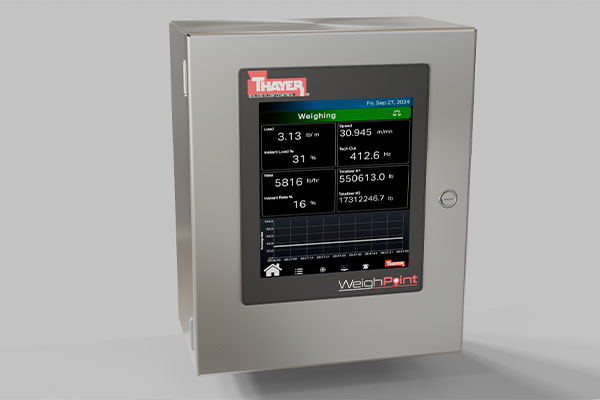
Whichever scale design is selected, every Thayer Scale weigh belt feeder is paired with one of the company’s proprietary instrumentation platforms. The electronics layer — not just the mechanical scale — is where signal filtering, calibration routines, and rate-control algorithms turn raw load-cell and belt speed signals into a stable, repeatable rate measurements. That combination of a purpose-engineered scale mechanism and matched instrumentation is what allows Thayer Scale to hold its accuracy claims across such a wide range of materials, capacities, and environments.
The Bottom Line
Thayer Scale doesn’t offer four scale designs because one design failed to work. It offers four because no single mechanical approach can be optimal for a 2 lbs./ft sanitary snack food line and a heavy-duty mining application at the same time. Mass-Counterbalanced Flexure, D-Lever, Blade Weighbridge, and ACCU-FLEX each solve a different combination of load, accuracy, ruggedness, and sanitation requirements — and choosing the right one is the difference between a feeder that meets spec on day one but quickly drifts out of tolerance, and one that performs reliably and holds its accuracy for decades.
READY TO TALK?
If you’re specifying a weigh belt feeder and aren’t sure which scale design fits your application, Thayer Scale’s engineering team can help you match the right scale, feeder model, and instrumentation to your process.